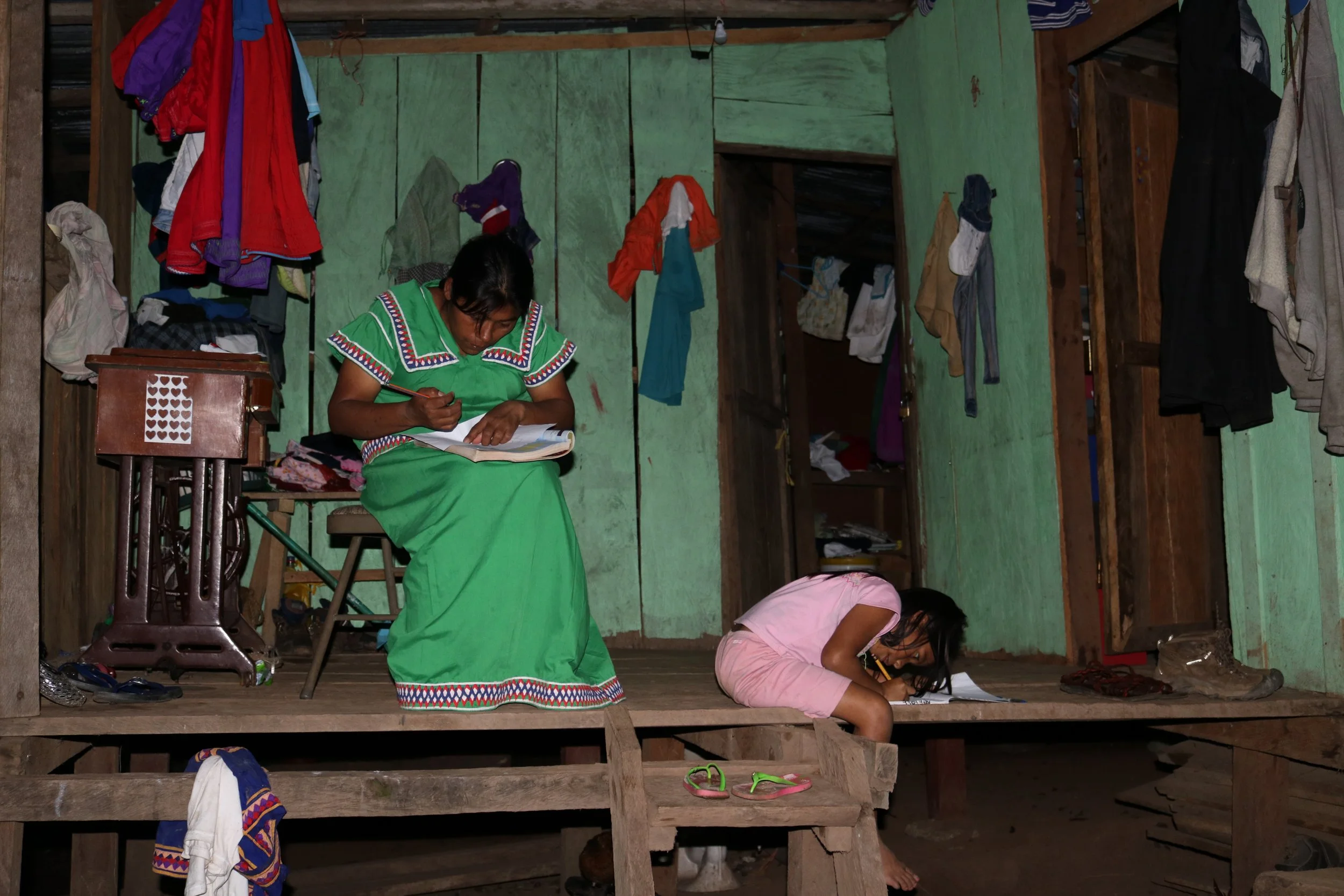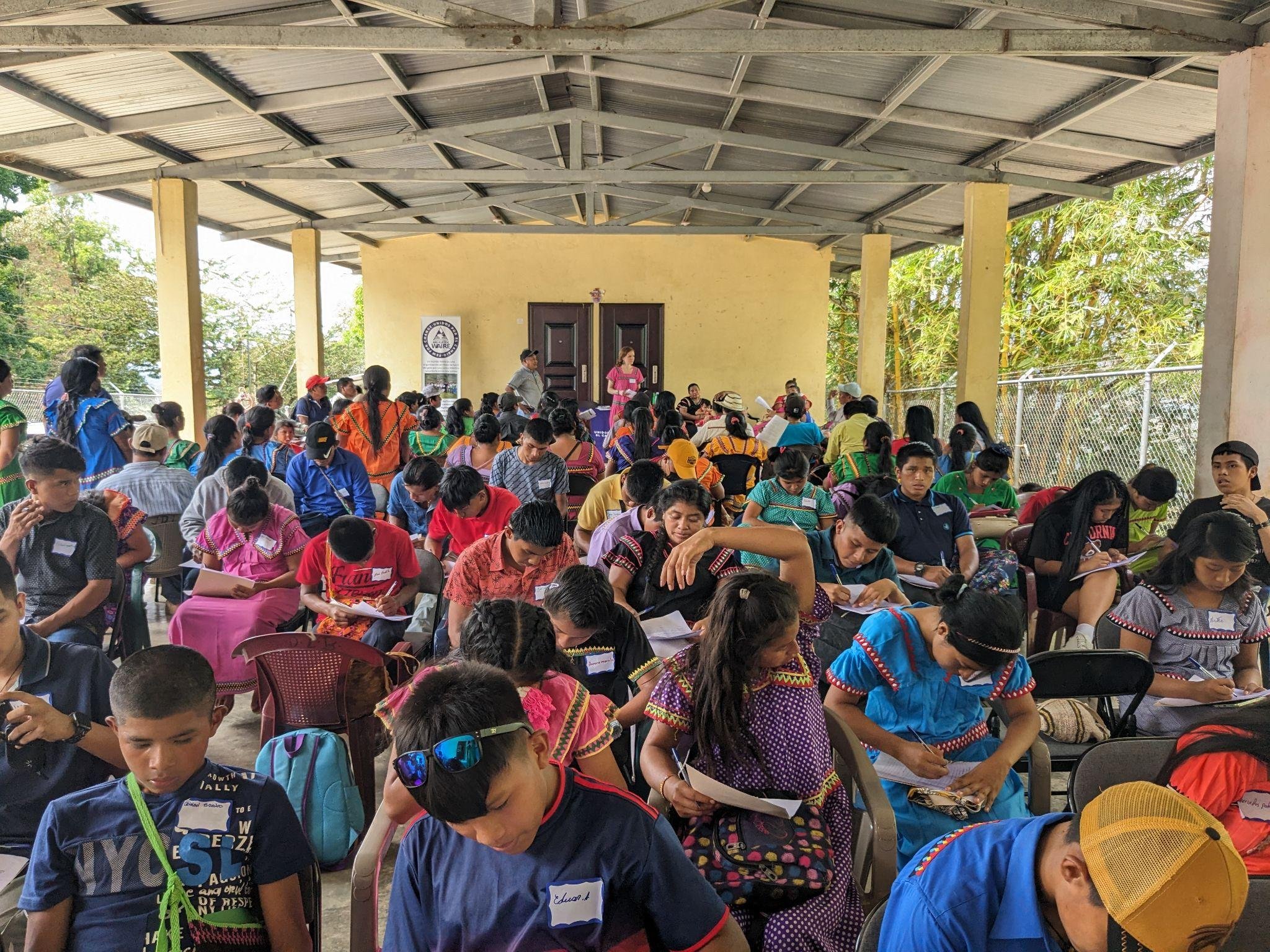
One of our guiding principles when we started Few for Change in 2009 was a simple but deeply held belief: the majority of every dollar donated should go directly to the communities with which we work. Primarily through scholarships but also through supporting workshops, buying supplies, or providing other community support, our goal has always been to strengthen access to education to help break the cycle of poverty in the Ngäbe-Buglé Comarca.
Now, nearly two decades later, we want to share with our donors how that commitment has held up over time.
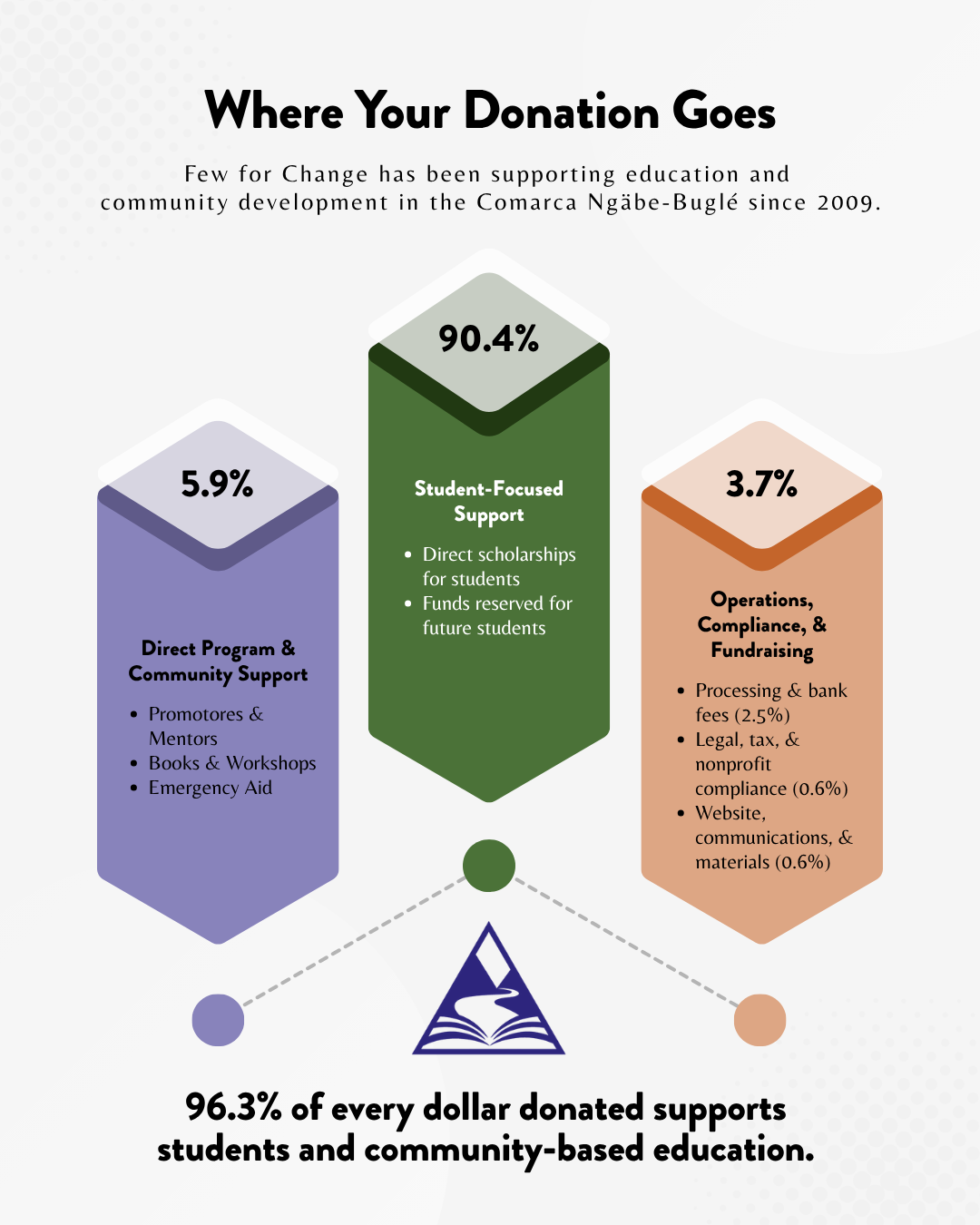
For every dollar donated, 96.3% directly supports students and community-based education.
That support takes many forms. 90.4% of all donated funds have been paid directly to students as scholarships or are formally reserved for specific students with ongoing educational commitments. An additional 5.9% supports direct community and educational programs—such as local promotores, who coordinate all of our operations on the ground to ensure that our students receive their scholarships. Our promotores also plan workshops, and mentor students. Our funding also helps to pay for supplies, workshops, emergency assistance, and community resilience initiatives. Together, these funds go straight to the people and programs our donors intend to support.
The remaining 3.7% of donations cover essential operations. These include banking and donation processing fees, secure international fund transfers, required legal and tax filings, and basic website and communication costs. Few for Change does not pay any U.S. staff, has no physical office, and is entirely volunteer-run.
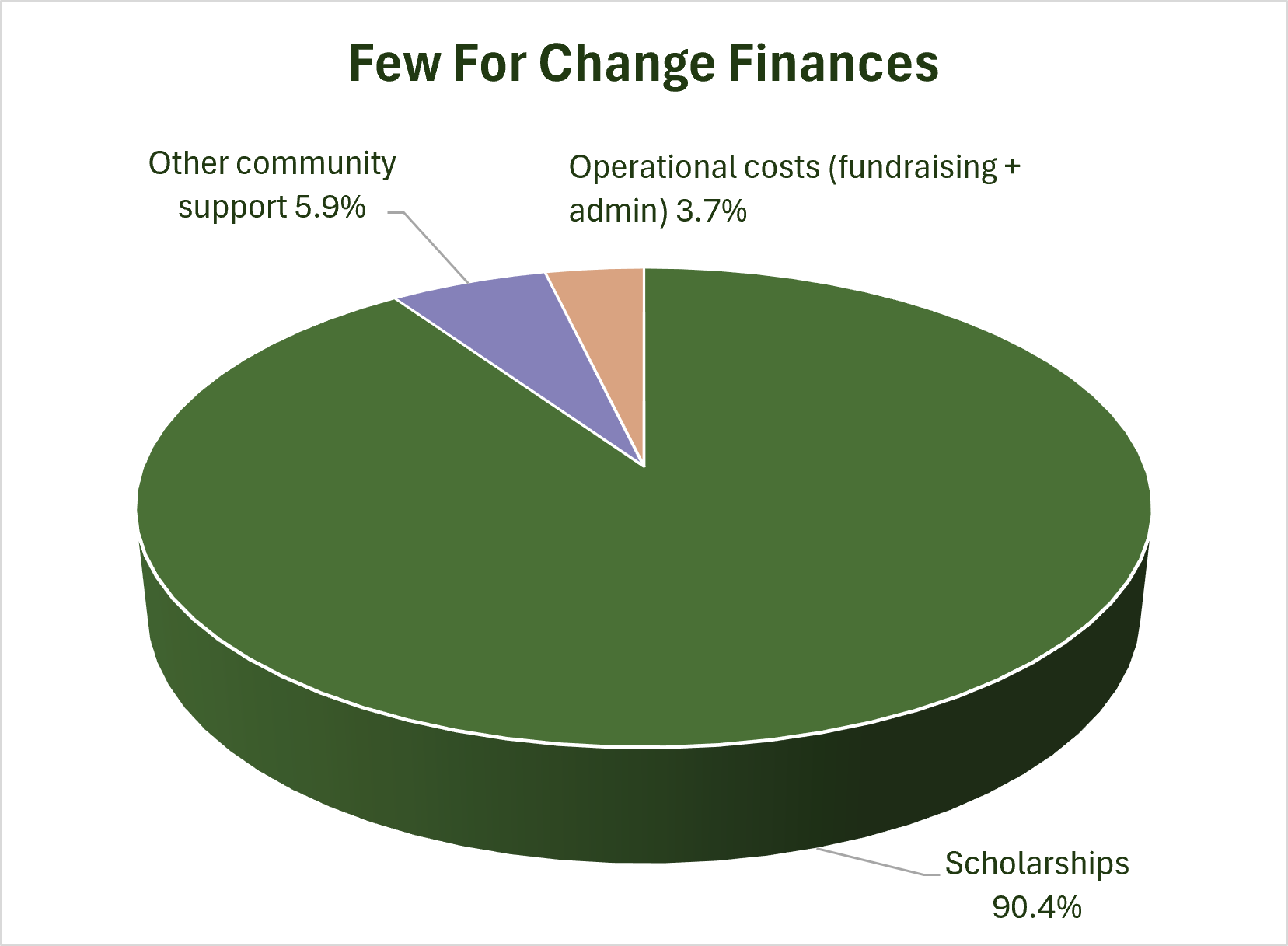
Over 90% of every dollar donated to Few for Change goes to scholarships. Almost 6% goes to other community support, and less than 4% goes to administrative costs.
Few for Change does not pay any U.S. staff, has no physical office, and is entirely volunteer-run.
Few for Change’s cost ratios are unusual for a mission-based nonprofit organization. The Charities Review Council recommends that nonprofits spend at least 65% of funds on programming, leaving no more than 35% of funds to fundraising and administration combined. Charity Watch considers a charity highly efficient if at least 75% of its funds go to its programs.
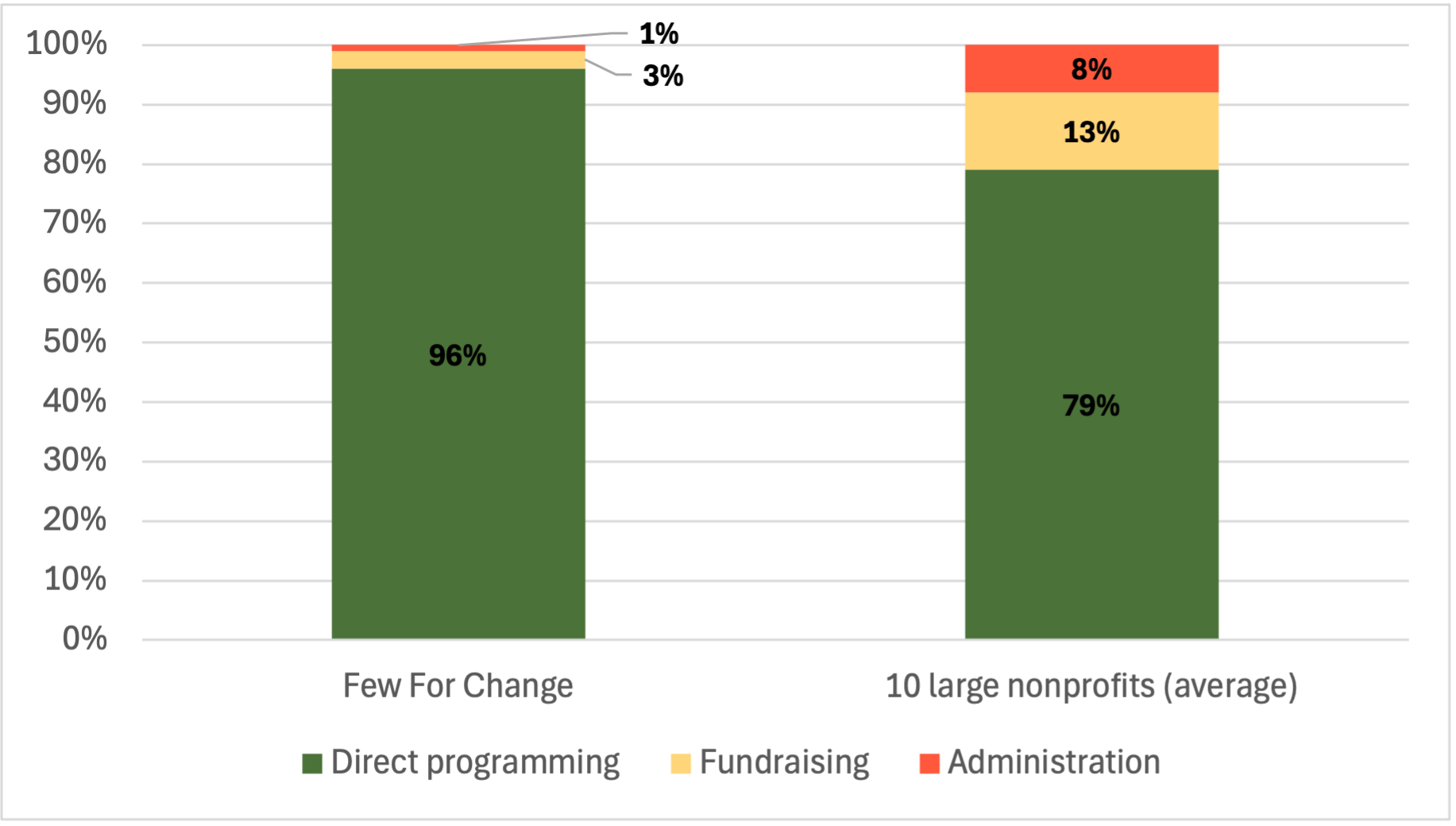
On average, about 17% more of Few for Change’s overall budget goes to direct programming compared to 10 large nonprofit organizations.
Large nonprofit organizations tend to fall into these ranges. In 2015, an analysis of tax documents from Syracuse University of 10 well-known nonprofits found that programming costs ranged from 60-90%. But even the organization with the highest program percentage was spending over half of its entire budget on employee salaries and benefits, which are typically included in “program costs.”
Because Few for Change has no employees, the closest thing we have to employee salaries is the 5.9% of our total budget that goes toward stipends for the Junta Directiva (board) members in Panama. These funds cover the transportation costs and supplies that are needed to run the essential tasks of Few for Change in the Comarca. On the U.S. side, we cover those costs as part of our personal donations of money, time, and effort. For our volunteers in the Comarca, the time and effort are still donated, but it is not sustainable for them to pay for their own transportation or supplies.
So, why give your hard-earned money to Few for Change when there are so many worthy causes to support? With Few for Change, your donation is maximized into creating a tangible difference:
Our mission and leadership come from the indigenous communities we serve. We will continue to decolonize our own structure as we support the Comarca leaders’ visions for their own communities.
We use an evidence-based model to make change. We use a direct cash-transfer system, which is demonstrably effective at lowering child labor rates, improving school attendance and child health, and alleviating poverty rates for families.
We build sustainable futures for families. The only condition for the scholarships we offer is that students remain in school and maintain a decent GPA (equivalent to about a 2.8 on the U.S. system). This supports a sustainable model of community development through education in a community where very few nonprofit organizations operate. Research shows that improving educational rates in communities is linked to economic growth, less inequality, better health outcomes, and less vulnerability to natural disasters and climate change.
Our support is direct. Of every dollar donated, 90 cents go directly into a student’s bank account, and serves as a vote of confidence in their education. Another 6 cents go to supporting educational development in their community, and the remaining 4 cents go to related fees.
It’s working! After 14 years of investment in education, Few for Change has supported six students as they crossed the University finish line in the last two years. We’ve supported a student who now attends university in the U.S. Two of our scholarship recipients are now members of the board of directors in Panama, and more are on deck. And FFC scholars are staying in school much longer than their peers: while roughly 18% of students in the Comarca attend school beyond 6th grade and about 10% of indigenous Panamanians complete high school, at least 52% of Few for Change scholarship recipients graduate from high school.
As the program continues to grow, maintaining such a low overhead will become more challenging. Inevitably, some of the money we typically set aside for scholarships will be diverted to support our growing numbers of Ngäbe volunteers, as we build more infrastructure to support more students. Our leaders on the ground have already identified five new members-in-training (all of them scholarship recipients themselves), who will be able to assist as the program grows. The Ngäbe board is also working toward official nonprofit status in Panama and is building an office in the Comarca. These efforts require funding, but will provide crucial resources for students and volunteers.
Yet Few for Change will stay lean by relying on the professional skills of volunteers, intentionally seeking nonprofit discounts, and avoiding services that would otherwise require significant external costs, such as paid administrative support or outsourced web development. We look for every possible efficiency because every dollar matters. The goodwill, time, and effort of so many people have made it possible for this work - and this dream - to continue.
More than 96 cents of every dollar donated to Few for Change supports students and community-based education. This principle guided our founding, and it continues to guide us today.